


Farms as More-Than-Human Contact Zones
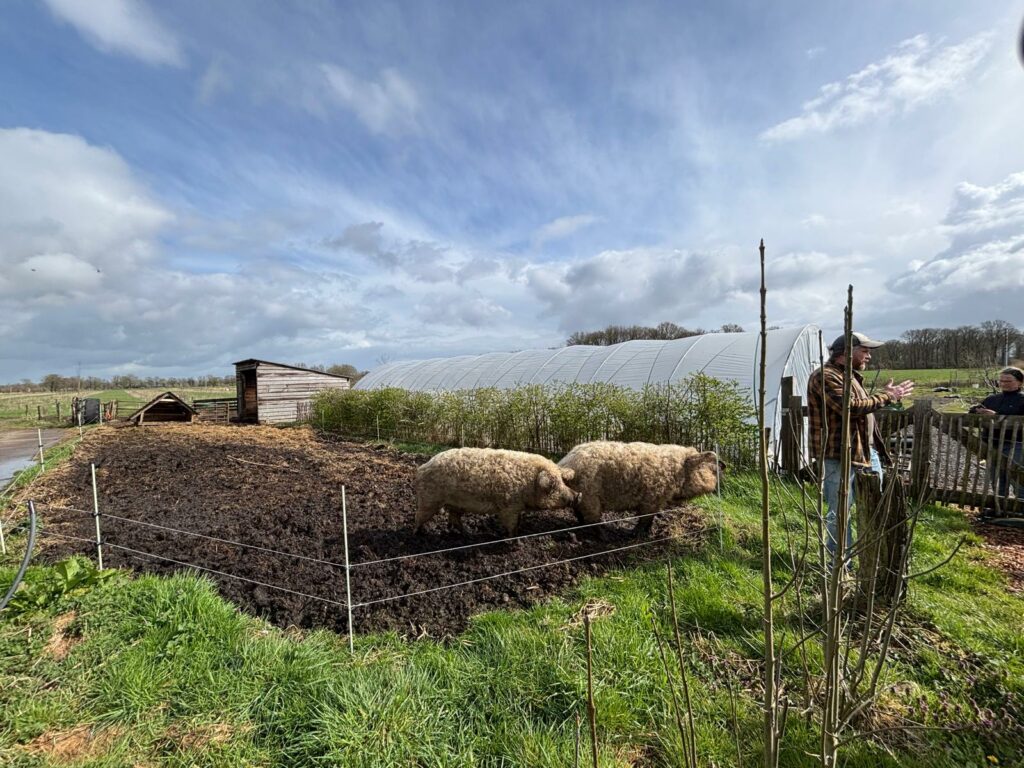
On farms, human and non-human animals live and work with, alongside, and sometimes at the expense of one another. Developments in rural areas are putting pressure on these relationships, but also create space for alternative ways of coexisting and collaborating. This research explores how such relationships may take shape on agroecological farms, focusing on the different types of knowledge involved, and how this knowledge is shared, shaped, and transmitted.
Background
Against the backdrop of climate change and biodiversity loss, this project focuses on agroecological farms in the Netherlands. Ongoing transformations in rural areas – including new construction and scaling-up, the repurposing of land and farms, and emerging agricultural practices – put relationships between human and non-human animals under pressure, while also offering new opportunities for coexistence and collaboration.
Understanding human–animal relations and the interconnectedness within and between ecological networks is becoming increasingly important in addressing the climate and biodiversity crises.
Nature-Inclusive Citizen Science
This research project takes a participatory approach. This means that the objectives, research questions, and implementation of the study are developed collaboratively with the research community. This community will take shape during the course of 2026 and will consist of research partners (such as farmers and their neighbours) and stakeholders (relevant organisations).
In addition, we explore the possibility of extending the concept of ‘citizen science’ by also including non-human animals in the research. This nature-inclusive approach constitutes a methodologically innovative aspect of the project, through which we aim to contribute to the further development of citizen science.
Methodology & Output
Drawing on the work of Donna Haraway and Louise Pratt, this research conceptualises farms as contact zones: sites where cultures and species meet, clash, and grapple with one another, often within strongly unequal power relations. This perspective highlights how both human and non-human animals are continuously shaped in and through their relationships with one another.
The research employs ethnographic methods, such as interviews and participatory observation with and of both humans and animals. Questionnaires will also be distributed.
The project will result, among other outputs, in microgeographies: small-scale maps that represent relationships between species at specific locations. Other outputs include publications, presentations, and tools, which will be developed in co-creation with the research community.
Working with nature-inclusive approaches and nature-inclusive knowledge forms the foundation of this research project. In practice, this entails maintaining a continuous critical perspective on the distinction between the natural and the cultural, as well as adopting a holistic approach.
Collaboration
The research team at the Meertens Institute collaborates closely within this programme with the citizen science research teams of the Huygens Institute and the International Institute of Social History.
In addition, we collaborate with colleagues from the sister project Homings, at Leiden University and the University of Helsinki.
Runtime: February 2026 –June 2028
Contact
Would you like to learn more about this research, do you have questions or suggestions, or would you like to get involved in any way? Please get in touch with researcher Marit van Dijk: marit.van.dijk@meertens.knaw.nl

